Before you spend money on another website, advert, or social media push — you need to know what stage your business is in online.
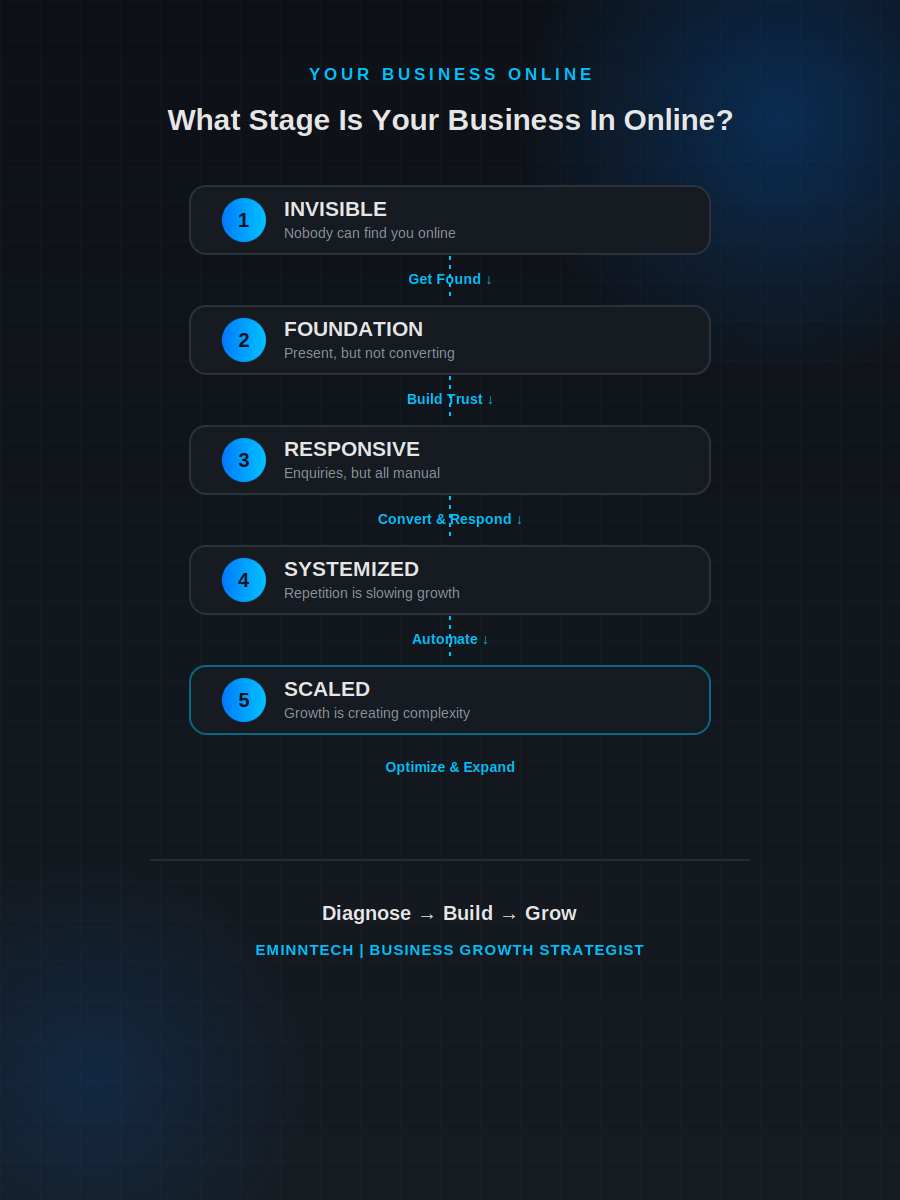
I've found that businesses tend to move through five broad stages:
- Invisible
- Foundation
- Responsive
- Systemized
- Scaled
The mistake is trying to use a Stage 5 solution to solve a Stage 1 problem.
Most businesses I audit sit somewhere between Stage 1 and Stage 3, and have no idea. That's not a criticism. Nobody ever walked them through it and showed them exactly where the gap is. So let's do that here, one stage at a time.
Invisible
A business in Stage 1 isn't necessarily doing badly. It might have loyal customers and steady word-of-mouth referrals. But the moment someone who doesn't already know them tries to find them, nothing happens.
Symptoms
- Difficult to find online
- Little or no Google presence
- No proper website
- Inconsistent digital information
- Customers mostly discover you through referrals or social media
Primary Problem
Visibility
The 60-second test:
- Search your business type plus your city — "boutique in Ibadan," "fast food Ibadan." Do you appear on the first page?
- Search your business name directly. Does anything come up — a Google Business listing, a website, a social page?
- Ask someone who's never visited your business to find you online in under a minute.
Word-of-mouth only reaches people who already know someone who knows you. Active searchers never find you at all. They're typing exactly what they want into Google right now, ready to buy. For most Stage 1 businesses, that's the majority of potential customers, invisible every single day.
The FixSet up your Google Business Profile. It's free and takes about 20 minutes: name, category, location, hours, real photos. This one thing is often the difference between showing up in local search and not existing at all.
Build one clear page that answers three questions: what do you sell, how much does it cost, how does someone contact you. Nothing else matters yet. Re-run the test — you should now show up, or at minimum be searchable by name with real information attached.
Foundation
Stage 2 is the most dangerous stage. From the outside it looks fine — a page exists, a listing exists. The box is checked. But "exists" and "works" are two different things, and this is where businesses quietly lose customers without ever realizing it.
Symptoms
- Website exists but is weak
- Poor mobile experience
- No clear conversion path
- Social profiles aren't connected properly
- Customers don't know what to do next
Primary Problem
Trust + conversion
What I check on every audit:
- Load speed — open it on mobile data, not wifi. Past 3 seconds, a large share of visitors have already left.
- Clarity in 3 seconds — can someone instantly tell what you sell and roughly what it costs, without scrolling and searching?
- Mobile experience — over 90% of Nigerian customers browse on mobile. If it's not built mobile-first, it's built for almost nobody.
- Contact visibility — is a WhatsApp button or phone number visible immediately, no scrolling required?
Here's the uncomfortable truth. This business found the customer. Google worked, the customer clicked — and then the website itself sent them away. That's not a visibility problem anymore, it's a conversion problem. It's invisible to the owner unless someone actually tests it the way a real customer would.
The Fix- Fix speed. Compress images. Cut anything that's decorative rather than functional.
- Say the price and offer clearly, immediately. Don't make people dig.
- Design mobile-first, not mobile-adjusted. Start on a phone-sized layout and work up.
- Put the WhatsApp button above the fold. It should be visible the moment the page loads. In Nigeria, WhatsApp is often where the actual sale happens — the website's only job is getting people to that button fast.
Responsive
By Stage 3, the business is found, the site loads fast, it's clear, it works on mobile, the WhatsApp button is right there. On paper, the work is done. And they're still losing customers, because of what happens after someone clicks that button.
Symptoms
- WhatsApp enquiries
- Website enquiries
- Social media messages, leads, orders
- Everything still highly manual
Primary Problem
Operational friction
The test: message the business exactly like a real customer would — "Hi, are you open?" or "What's the price for this?" Then time the reply.
- Under 5 minutes — genuinely good, and rare.
- 5–30 minutes — attention is already fading; they may already be browsing a competitor.
- Past 30 minutes, or hours later — that customer is very likely gone. Not because the product or price was wrong. Because nobody answered in time, and somebody else did.
This isn't a visibility problem or a website problem. Both are already fixed. It's purely a response-time problem — and it's the single biggest reason businesses that look completely fine on the outside still aren't converting customers who are genuinely interested and already knocking on the door.
The FixThe obvious answer, "reply faster," isn't realistic. You're running the business, handling stock, dealing with suppliers — and somehow also expected to be glued to WhatsApp 24 hours a day. That doesn't scale.
The real fix is an AI assistant that handles the first response instantly, every time, day or night. It answers common questions, takes order details, and only pulls in a human when something genuinely needs judgment. I built exactly this for a food vendor: 40+ customer interactions handled per day, fully automated, orders taken and questions answered instantly, all day and all night.
Systemized
Stage 4 is the stage most businesses never reach — not because it's expensive or complicated, but because nobody ever showed them it was possible. A Stage 4 business doesn't run on the owner constantly doing everything manually. It runs on systems that keep working whether the owner is actively there or not.
Examples
- Repetitive customer questions
- Manual order processing
- Lead follow-up
- Appointment scheduling
- Internal workflows
Primary Problem
Outgrowing manual work
Take that same food vendor system as the real example. A customer messages on WhatsApp any time, day or night. The AI assistant replies instantly, in the vendor's own tone, handling menu questions, prices, and order details without a human touching the phone. 40+ of these interactions happen in a single day, fully automated. The owner isn't retyping the same five answers over and over, and isn't losing customers to slow replies. The system just runs, in the background, while the owner focuses on the actual business.
Stages 1 through 3 are about removing what's broken: being found, looking right, responding fast. Stage 4 is different. It's about the business no longer depending entirely on the owner's constant manual effort just to function. This is where AI, automation, and integrations become relevant.
Scaled
Being systemized isn't the finish line. Automation without tracking is just a system running blind. It might be working well, badly, or barely at all — and without checking, nobody actually knows which.
Already in place
- Traffic
- Customers
- Systems
- Data
- Processes
The question becomes
How do we grow output without adding complexity at the same rate?
Moving into Stage 5 comes down to three things:
- Track what's actually happening. How many messages come in daily, how many turn into orders, where people drop off.
- Find the biggest leak, and fix only that. Once you can see the numbers, one thing is usually costing more than everything else combined. Fix that first, not everything at once.
- Repeat, constantly. Stage 5 businesses aren't perfect — they're simply never standing still. Check the numbers, fix the next biggest leak, check again.
A Stage 5 business is data-driven. The owner isn't guessing what's working — they know, because they're checking. It's found easily, it looks right the moment someone lands on it, it responds instantly, it's automated where it should be, and it's improving on purpose, based on real numbers, all the time. Focus at this stage can include advanced automation, conversion optimization, SEO and content expansion, analytics, CRM systems, custom software, and growth experiments.
How do I know which stage my business is in?
| If your business looks like this… | You may be here |
|---|---|
| People struggle to find you | Invisible |
| You're online but don't convert attention well | Foundation |
| You're getting enquiries but handling everything manually | Responsive |
| Repetitive processes are slowing you down | Systemized |
| Your systems work but growth is creating complexity | Scaled |
The goal isn't to skip stages. The goal is to find the bottleneck you're facing right now, and solve that bottleneck before adding more complexity. That's Business Growth Strategist thinking.
This framework is also how I approach projects at EminnTech.
I don't believe every business needs the same solution. A business struggling to get discovered doesn't necessarily need an advanced AI system. A business already processing hundreds of customer conversations may have a completely different problem.
The technology should follow the business problem, not the other way around.
My role is to diagnose the problem, decide what needs to change, then build or implement the system that moves the business forward.
The full recap
| Stage | What's happening |
|---|---|
| 1. Invisible | Nobody can find you online. |
| 2. Foundation | Something exists, but it's broken in ways you can't always see yourself. |
| 3. Responsive | Found, and looks fine — but losing customers to slow replies. |
| 4. Systemized | Automated and consistent — no longer dependent on the owner doing everything by hand. |
| 5. Scaled | Tracking, optimizing, and genuinely growing on autopilot. |
If you read through these five stages and recognized your own business somewhere in there, that's exactly the starting point. Most businesses sit between Stage 1 and Stage 3 without realizing it. Closing that gap is usually far simpler and cheaper than owners assume.
Which stage is your business in?
Tell me what you're working with and I'll give you a straight read on your stage and the very next step.
Get a Free Read